
A purity figure of 99% sounds simple, but it measures something narrower than most people assume. At Helix Forge Canada, every catalog compound is held to a ≥99% HPLC purity standard, so it is worth knowing exactly what that number covers.
It does not mean 99% of the powder in the vial is peptide. It means 99% of the peptide material is the correct sequence, and that difference changes how a Certificate of Analysis (CoA) should be read.
Key Takeaways
- A 99% purity rating refers to HPLC peak area: the share of peptide material that is the target sequence.
- Net peptide content is a separate figure and is lower, because water and salts add weight.
- Identity, endotoxin status, and salt form each need their own test.
- The remaining 1% consists of near-miss sequences from synthesis, such as truncated, deletion, and oxidized variants.
- A credible CoA reports a measured value, such as 99.3%, because HPLC cannot verify a “100% purity” claim.
- Residual TFA salts can interfere with sensitive cell-based assays, so the salt form is worth checking.
What Does a 99% Purity Rating Measure?
A 99% purity rating means the target peptide makes up 99% of the peptide material detected by HPLC, measured by peak area. It describes how much of the peptide content is the correct sequence, not how much of the vial’s weight is peptide.
HPLC (high-performance liquid chromatography) separates a dissolved sample into its components, and a detector records each one as a peak. In a clean sample, one tall, sharp peak dominates the graph.
If that peak covers 99% of the total area, the sample is reported as 99% pure. A chromatogram with several sizeable side peaks points to a poorly made or degraded batch. Background on peptide structure is in the complete guide to peptides for researchers.
How Is Purity Different From Net Peptide Content?
Purity measures whether the peptide material is the right sequence. Net peptide content measures how much of the total powder weight is peptide at all. A vial can show 99% purity while its net peptide content is well below 100%, because water and salts also make up part of the weight.
Freeze-dried peptides hold on to some moisture, and they are supplied as salts to stay stable. Neither counts against purity, but both lower net peptide content.
| CoA Measurement | What It Tells You | What to Look For |
| HPLC purity | Share of peptide material that is the target sequence | A single dominant peak; ≥99% for Helix Forge catalog compounds |
| Net peptide content | Share of total powder weight that is peptide | A figure below 100%, explained by water and salt content |
| Mass spectrometry | Whether the compound’s molecular weight matches the target | Observed mass matching expected mass |
| Endotoxin test | Whether bacterial endotoxins are present | A passing result for cell-based work |
What Makes Up the Remaining 1%?
The remaining 1% is made of peptide-related impurities created during synthesis, usually solid-phase peptide synthesis (SPPS), where amino acids are added one at a time. Small errors at any step leave sequences close to, but not exactly, the target:
- Truncated sequences: chains where assembly stopped early, leaving a shorter peptide.
- Deletion sequences: chains missing one or more amino acids from the middle.
- Insertion sequences: chains with an extra amino acid added by a repeated coupling step.
- Incompletely deprotected peptides: chains that still carry chemical protecting groups that should have been removed.
- Oxidized variants: sequences where sensitive amino acids, such as methionine, have reacted with oxygen.
- Racemized variants: sequences where an amino acid has flipped into its mirror-image form.
- Dimers and aggregates: two or more peptide chains that have joined together.
Water, salts, and counter-ions affect net peptide content, not this 1%.
What Doesn’t a Purity Number Tell You?
A purity figure confirms that the peptide material is mostly one sequence. It does not confirm which sequence it is, whether the sample is free of bacterial contamination, or what salt form the peptide is in.
- Identity: Mass spectrometry confirms the compound is the peptide ordered. A highly pure batch of the wrong compound would still pass an HPLC purity check.
- Endotoxins: Purity is a chemical measure. Endotoxins are fragments of bacterial cell walls, detected with a separate test such as the LAL (limulus amebocyte lysate) assay.
- Counter-ions: Peptides are often purified with trifluoroacetic acid (TFA), which can remain as a TFA salt. Residual TFA can interfere with some sensitive cell-based assays, so some labs request an acetate or hydrochloride salt form instead.
Treat any “100% purity” claim with suspicion. HPLC has detection limits and cannot prove the total absence of impurities, so a credible CoA reports a measured value, such as 99.3%, rather than a perfect score.
Reading a Purity Result in One View
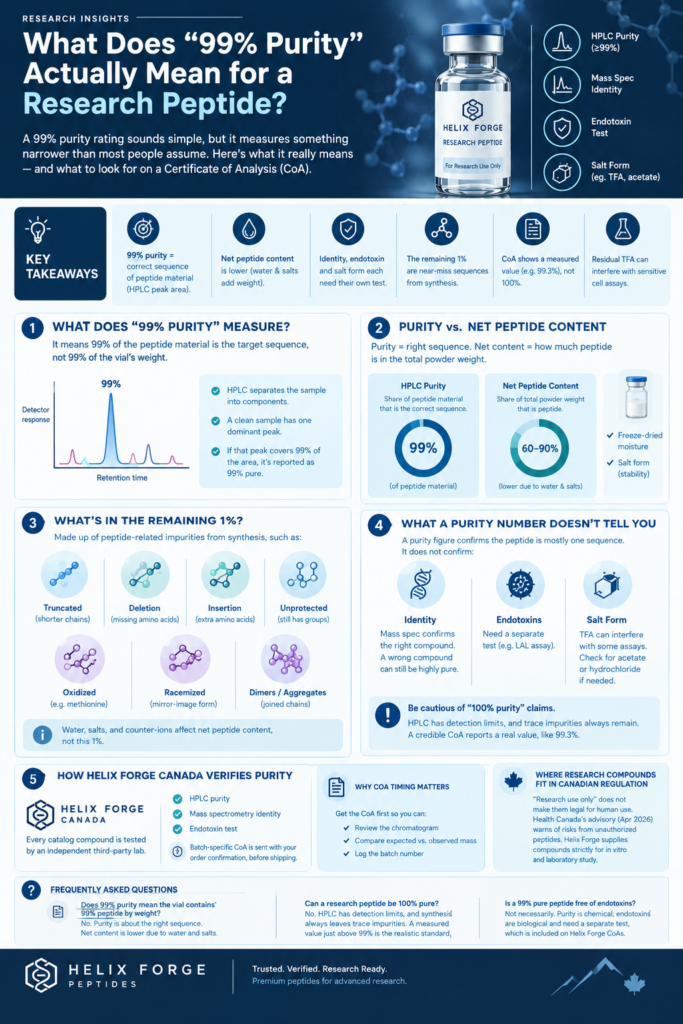
Purity, net peptide content, impurities, and the tests a purity figure can’t replace all fit together on a single CoA. The visual below brings them into one view.
How Does Helix Forge Canada Verify Purity?
Helix Forge Canada states that every catalog compound is tested by an independent third-party laboratory for HPLC purity, mass spectrometry identity, and endotoxins. The batch-specific CoA is issued with the order confirmation, before the compound ships.
Why CoA Timing Matters
Receiving the CoA first lets a researcher review the chromatogram, compare expected and observed mass, and log the batch number before work begins. Documentation shared only after delivery delays that check. The guide to choosing a trusted peptide supplier in Canada covers the other checks worth making before ordering.
Where Research Compounds Fit in Canadian Regulation
Purity data also matters because of how research compounds are regulated. Health Canada’s April 2026 public advisory on unauthorized injectable peptides states that “research use only” labelling does not make unauthorized products legal for human use, and CBC News reporting on online peptide sales describes experts calling the market a regulatory grey zone.
The Canada research compound regulations guide explains where legitimate research supply sits within that framework.
Research Peptides Are Not Supplements
A research peptide with a 99% purity CoA is still a laboratory compound, not a health product. The comparison of research peptides and peptide supplements explains how the two categories differ. Helix Forge supplies compounds strictly for in vitro and laboratory study.
Frequently Asked Questions
Does 99% purity mean the vial contains 99% peptide by weight?
No. Purity measures the share of peptide material that is the correct sequence. The share of total powder weight that is peptide is a separate figure called net peptide content, which is lower because of water and salts.
Can a research peptide be 100% pure?
No credible CoA can verify 100% purity. HPLC has detection limits, and synthesis always leaves trace impurities, so a measured value just above 99% is the realistic high standard.
Is a 99% pure peptide free of endotoxins?
Not necessarily. Purity is chemical; endotoxin contamination is biological and needs a separate test, which Helix Forge Canada includes on its CoAs.