
The terms “research-grade” and “supplement-grade” can sound like official quality categories, but they are not interchangeable regulatory terms in Canada. For peptide research, the more useful question is what the material is intended for and what analytical documentation supports the specific batch.
And if you’re looking for a reliable research-grade compound, Forge Peptides shop is just a few taps away. Only high-quality and top-grade products await you!
What Is a Research-Grade Peptide?
A research-grade peptide is generally a peptide compound supplied for laboratory, analytical, academic, or other research purposes. The phrase itself is not a Canadian regulatory designation, so the label “research-grade” should not be treated as proof of a particular standard.
For a research laboratory, the useful evidence is found in the supporting documentation. That can include a Certificate of Analysis, batch number, HPLC results, mass spectrometry data, and information about the laboratory that performed the testing.
Helix Forge describes its peptide compounds as reference materials intended strictly for laboratory, academic, analytical, and in vitro research.
Is Supplement-Grade a Formal Canadian Peptide Category?
No. “Supplement-grade” is not a standalone Canadian regulatory classification that automatically establishes a product’s quality or legal status.
In Canada, a product may fall under the Natural Health Products Regulations if it meets the definition of a natural health product. Products in that framework require a product licence before they are marketed, and licensed products carry an eight-digit Natural Product Number or NPN.
Health Canada also looks at how a product is represented. That can include claims made on labels, websites, advertisements, and other materials. The intended representation can therefore matter when determining the applicable regulatory framework.
What Actually Separates the Two?
The clearest difference is intended use and the documentation supporting that use.
A research compound is positioned for laboratory or analytical work. A regulated natural health product, by contrast, is subject to requirements tied to its authorized product framework, including licensing and required labeling.
For researchers comparing peptide suppliers, several practical questions are more useful than a grade label:
- Is the material supplied for research purposes?
- Is the batch identified?
- Is a batch-specific CoA available?
- What analytical method supports the stated purity?
- Is identity testing documented?
- Who performed the testing?
- Can the analytical record be connected to the exact material supplied?
A simple grade name cannot answer all of those questions.
Research peptide documentation at a glance
What to checkWhy it matters
Batch number Connects the material to a specific production batch
HPLC result Provides chromatographic purity information
Mass spectrometry Provides information used for identity confirmation
CoA Records analytical information for the specific batch
Testing laboratory Shows who performed the reported analysis
Intended-use statement Clarifies whether the material is positioned for research
Why Does a Peptide CoA Matter?
A Certificate of Analysis gives a laboratory a record of analytical information associated with a particular batch. It is more useful when the document clearly connects the compound name, batch number, test results, and testing information.
Helix Forge states that each shipment includes a batch-specific CoA and that its catalog compounds undergo independent laboratory analysis. The company also states that its catalog compounds are verified at ≥99% purity by HPLC and that mass spectrometry is used for identity confirmation.
That documentation can become part of a laboratory’s research records.
It does not, by itself, establish that a compound is suitable for every possible research application.
How Do HPLC and Mass Spectrometry Differ?
HPLC and mass spectrometry provide different types of analytical information.
HPLC can separate components in a sample and provide a chromatographic purity measurement. Mass spectrometry can provide molecular-mass information that helps support compound identity.
Helix Forge Peptides describes both methods in its Molecular Research Guide and states that they are used as part of its verification process.
That makes the combination more informative than a product page that simply states a percentage without showing how the figure was determined.
Example: If a CoA lists a specific batch number, an HPLC purity result, and mass spectrometry confirmation, a researcher can retain those records with the documentation for the material used in the study.
How Does Helix Forge Document Its Peptides?
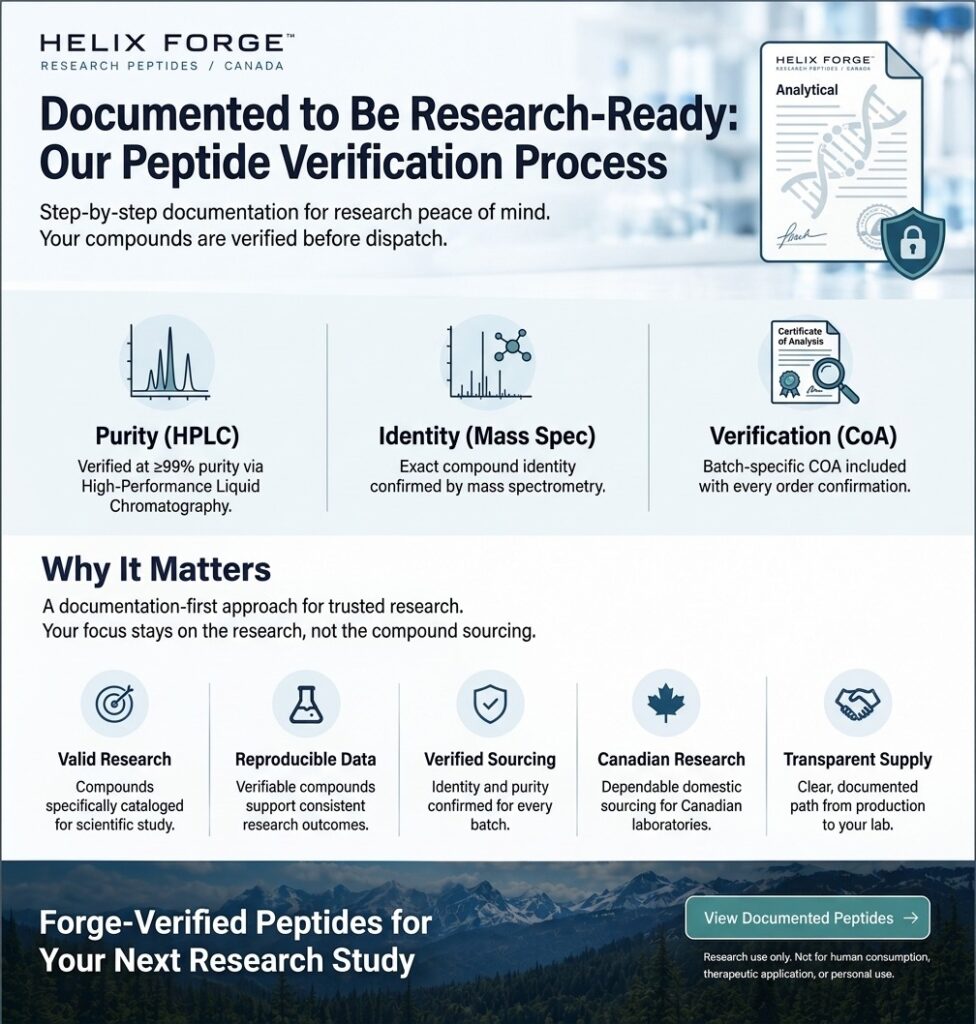
Helix focuses its Canadian peptide catalog around documented research compounds. Its website states that each batch is independently analyzed, with ≥99% purity verified by HPLC, mass spectrometry used for identity confirmation, and a batch-specific CoA included with each order.
Its Molecular Research Guide also states that the CoA is provided with the order confirmation before the compound ships. According to the site, researchers can therefore review the batch information before the material leaves the facility.
This documentation-first approach is more useful than relying on the phrase Helix Pure Peptides or another marketing description alone. The relevant question remains the same: what information is provided for the specific compound and batch?
What Should Canadian Researchers Look For?
Researchers comparing Helix peptides with another supplier should start with the analytical record rather than the product name.
A practical review can include:
- The exact compound name
- Batch or lot identification
- Reported HPLC purity
- Mass spectrometry results
- Testing laboratory information
- Date of analysis
- Any additional tests relevant to the planned research
- A clear statement of intended research use
Where Can Researchers Find Forge Peptides in Canada?
Helix Forge offers peptide reference compounds to research environments in Canada and publishes analytical information intended to help researchers evaluate the material before working with it.
For a laboratory evaluating Forge Peptides in Canada, the strongest reason to review Helix Forge is not the name itself. It is the documentation behind the individual compound.
Researchers can review the available compound information, analytical specifications, and CoA documentation before deciding whether a particular material fits their laboratory requirements.
The Practical Difference Comes Down to Documentation
“Research-grade” and “supplement-grade” are not enough on their own to establish what a peptide is or how it should be classified in Canada. For research work, the more useful evidence is the combination of intended use, batch identification, analytical testing, and documentation.
For Canadian laboratories looking for Forge Peptides, Helix Forge provides a research-focused catalog with published information on HPLC purity verification, mass spectrometry identity confirmation, independent testing, and batch-specific CoAs.
Frequently Asked Questions
Are research-grade peptides regulated in Canada?
“Research-grade” is not, by itself, a Canadian regulatory classification. The applicable framework depends on the product and how it is represented, including its intended purpose and claims. CCanada
Is supplement-grade an official Canadian quality standard?
No. “Supplement-grade” is not a standalone regulatory quality designation. Products marketed as natural health products must meet the applicable Canadian requirements, including product licensing where required. CCanada+1
What should a peptide CoA contain?
A useful CoA should identify the compound and batch and report relevant analytical results. Depending on the material, this may include HPLC purity, mass spectrometry information, testing dates, and laboratory details.
Does Helix Forge provide batch-specific CoAs?
Yes. Helix Forge states that its orders include batch-specific Certificates of Analysis and that its catalog compounds undergo independent analytical testing.
Why does batch traceability matter?
Batch identification connects the analytical record to the material received by the laboratory. That can help researchers maintain clearer records when documenting materials used in laboratory work.