
Metabolic signals refer to the biochemical messages that regulate how the body processes energy, handles blood sugar, controls appetite, and most importantly, breaks down fat. In this article, we’re going to focus on how this specific category used in peptide research is being classified.
Understanding that classification logic makes it easier to evaluate any specific compound, rather than treating the category as one undifferentiated list where every entry is assumed to work the same way.
Here at Forge Peptides, we make sure you understand every product we offer. This guide will focus on metabolic signal peptides and what researchers should know before evaluating them.
What Actually Defines the Metabolic Signal Category
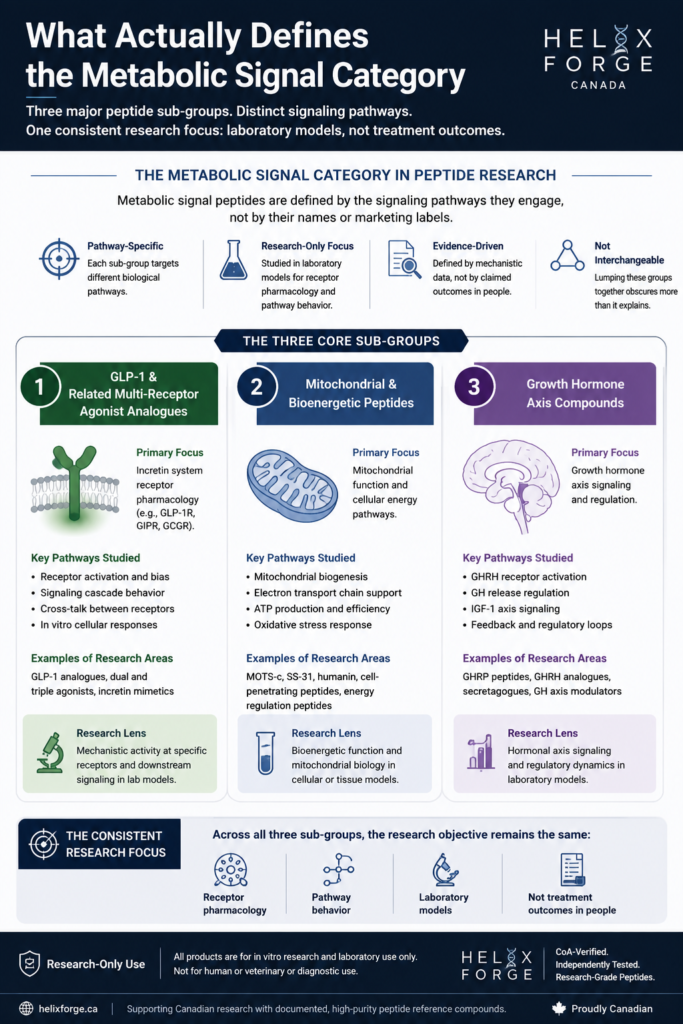
Three sub-groups make up most of the metabolic signal in peptide: GLP-1 and related multi-receptor agonist analogues, mitochondrial and bioenergetic peptides, and growth hormone axis compounds. Each group is studied for a distinct signaling pathway, and lumping them together by name alone tends to obscure more than it explains.
The research focus across all three stays consistent even though the mechanisms differ: receptor pharmacology and pathway behavior in laboratory models, not treatment outcomes in people.
Multi-receptor agonist analogues
This sub-group includes compounds studied for their interaction with more than one metabolic receptor at once.
| Compound | Receptor Targets | Research Focus |
| Tirzepatide | GIP and GLP-1 | Incretin hormone signaling and metabolic regulation |
| Survodutide | GLP-1 and glucagon | Dual receptor co-activation and metabolic signaling pathways |
| Retatrutide | GIP, GLP-1, and glucagon | Triple receptor signaling in metabolic research models |
| Mazdutide | GLP-1 and glucagon | Receptor co-activation and energy homeostasis signaling |
The common thread across this group is co-activation. Each compound is studied for what happens when more than one receptor pathway is engaged at the same time, rather than isolating a single target.
Where amylin signaling fits alongside this group
Cagrilintide is often discussed alongside GLP-1 compounds because it is frequently studied in combination protocols, but its actual receptor target is different. It is a long-acting amylin analogue, studied for amylin receptor signaling and energy homeostasis pathways specifically, which places it in a related but distinct research lane from the multi-agonist compounds above.
Mitochondrial and Bioenergetic Compounds
A second sub-group focuses on cellular energy production rather than receptor signaling in the classic sense.
- MOTS-c is a mitochondrial-derived peptide encoded within the 12S rRNA gene, studied for mitochondrial signaling and metabolic regulation in laboratory models.
- SS-31 targets the inner mitochondrial membrane, studied for mitochondrial bioenergetics and oxidative stress regulation.
- NAD+ is studied for cellular bioenergetics and redox signaling.
- L-Carnitine is studied for mitochondrial fatty acid transport and cellular bioenergetics signaling.
None of these compounds act on the same receptors as the GLP-1 class above. They share a category placement because the research question, cellular energy handling, sits under the same broad metabolic signaling umbrella, even though the underlying biology is closer to mitochondrial physiology than to hormone receptor pharmacology.
Growth hormone axis compounds
A third sub-group covers somatotropic and growth hormone axis research. Recombinant Human Growth Hormone variants and AOD 9064, studied for lipolytic signaling and adipocyte receptor pharmacology, both fall here because the research question centers on the growth hormone axis rather than a single receptor interaction.
Why the Classification Matters When Sourcing a Specific Compound
None of this taxonomy changes what documentation a researcher should expect. Every compound across all three sub-groups needs the same batch-specific verification: HPLC purity data, mass spectrometry identity confirmation, and a Certificate of Analysis issued before the order ships. Helix Forge Peptide applies that standard the same way across the entire Metabolic Signal category, regardless of which receptor pathway a specific compound targets.
Where the classification does matter is in evaluating research fit. A study built around receptor co-activation calls for a different compound than one built around mitochondrial bioenergetics, and understanding which sub-group a compound belongs to is the first step in that decision, well before documentation even enters the picture.
The Bottom Line
The Metabolic Signal category groups compounds by research focus, not by a single shared mechanism, which is why a GLP-1 multi-agonist and a mitochondrial peptide can sit in the same catalog section. What stays constant across every compound in the category is the documentation standard behind it.
Helix Forge Canada applies batch-specific verification across the full Metabolic Signal catalog, so the classification a compound falls into never changes how thoroughly it is tested. Review the current Metabolic Signal catalog at helixforge.co to see the documentation behind a specific compound before ordering.
Frequently Asked Questions About the Metabolic Signal Category
What makes a compound part of the Metabolic Signal category?
A research focus on receptor interaction or molecular stability within metabolic signaling pathways, studied in laboratory models rather than for any consumer outcome.
Are GLP-1 analogues and mitochondrial peptides studied the same way?
No. GLP-1 and related multi-agonist compounds are studied for receptor co-activation, while mitochondrial peptides like MOTS-c and SS-31 are studied for cellular energy production and oxidative stress regulation. Both fall under the same broad category despite the different mechanisms.
Does every compound in this category require the same documentation?
Yes. Batch-specific CoA data, HPLC purity verification, and mass spectrometry identity confirmation apply the same way across every sub-group, regardless of receptor target.