
KLOW peptide is a four-compound blend combining GHK-Cu, BPC-157, TB-500, and KPV. For researchers, the more useful question isn’t what the name means, but what is actually in the batch you are sourcing and how that material has been verified.
A product name tells you very little about the specific material in a vial. So if you’re here because you are considering buying this compound, you might want to pause and read this article first.
You can get KLOW peptide Canada delivered to you with just a few taps, but before that, know what you need to verify first here at Helix Forge.
What Is KLOW Peptide?
KLOW is a research formulation that combines four peptides commonly discussed separately in peptide research. One current research guide describes the formulation as GHK-Cu, KPV, BPC-157, and TB-500, with a total listed amount of 80 mg. It also describes the blend as a way to study multiple signaling pathways under controlled laboratory conditions.
- GHK-Cu is a copper-peptide complex studied in relation to copper-dependent signaling.
- KPV is an alpha-MSH-derived tripeptide investigated for inflammatory and melanocortin-linked signaling.
- BPC-157 is studied as a peptide-mediated signaling compound.
- TB-500, a thymosin beta-4 fragment, is examined in areas including actin and cytoskeletal dynamics.
The important point is that research on an individual peptide should not automatically be treated as evidence for the combined KLOW peptide. The blend itself needs to be evaluated as its own research material.
KLOW Blend
KLOW is commonly presented as a combination of GHK-Cu, BPC-157, TB-500, and KPV. One published formulation lists 50 mg of GHK-Cu and 10 mg each of KPV, BPC-157, and TB-500, for 80 mg total.
So researchers should verify the actual formulation from any peptide supplier in Canada, rather than assuming that every KLOW product follows the same ratio.
Before you buy KLOW peptide, check the product specification and CoA together. The product page tells you what the supplier says it is offering. The batch documentation should tell you what was tested.
What Should You Check Before Buying KLOW Peptide?
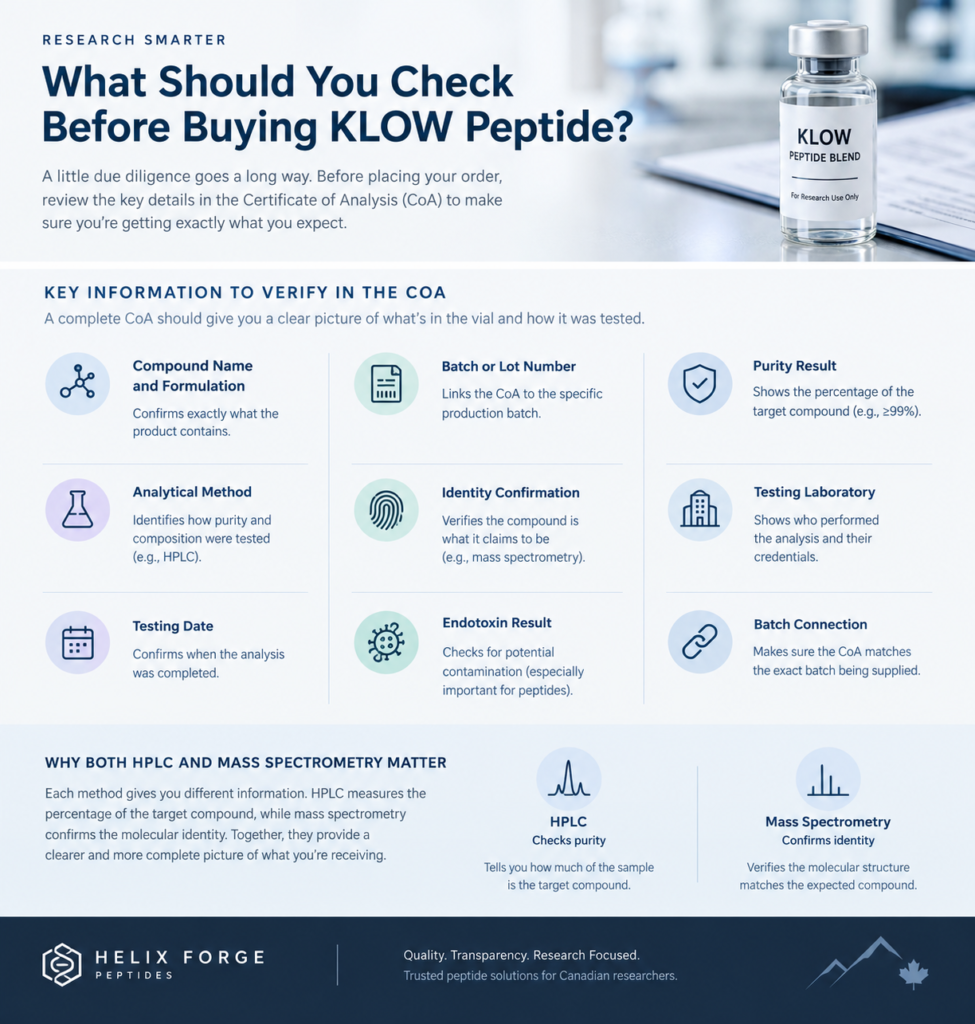
Let’s assume that you found your way here at Helix Forge peptides, ready to place the order. But before doing so, we want you to check the list below.
Start with the batch-specific Certificate of Analysis. A useful CoA should allow you to connect the material in your order to a specific production and testing record.
Check for:
- Compound name and formulation
- Batch or lot number
- Purity result
- Analytical method used for purity testing
- Identity confirmation
- Testing laboratory
- Testing date
- Relevant endotoxin result
- A clear connection between the CoA and the batch being supplied
HPLC and mass spectrometry serve different purposes. HPLC is used to assess the percentage of the sample represented by the target compound, while mass spectrometry provides identity information by comparing the measured molecular characteristics with the expected compound. Using both gives a clearer analytical picture than relying on a single number.
Why the CoA Matters
A CoA is more useful when it is tied to the actual batch being purchased. A generic document attached to a product category does not provide the same level of traceability as a batch-specific record.
Helix Canada states that every catalog compound is independently tested and accompanied by batch-specific analytical data. Its published quality process includes 99%+ purity verification by HPLC, mass spectrometry identity confirmation, third-party laboratory analysis, and a batch-specific CoA.
The timing also matters. Helix Forge says the CoA is issued with the order confirmation before the compound ships. That allows a researcher to review the analytical record before the material leaves the facility rather than discovering the documentation after delivery.
For laboratory work, this also gives researchers a straightforward documentation trail. The batch number on the vial can be matched with the batch number on the CoA and retained as part of the study record.
How to Compare KLOW Peptide Suppliers in Canada
Price is easy to compare. Documentation is not. If you are looking for a peptide supplier, compare suppliers based on what you can verify before ordering klow blend Canada.
A practical checklist is:
- Does the supplier clearly identify the KLOW formulation?
- Is the CoA specific to the batch?
- Is the testing laboratory identified?
- Does the documentation include HPLC purity results?
- Is compound identity independently confirmed?
- Is the batch number traceable?
- Are the products clearly restricted to laboratory research?
- Can the documentation be reviewed before shipment?
These questions are more useful than relying on phrases such as “premium,” “high quality,” or “research grade” without supporting information.
Why Consider Helix Forge Canada for KLOW?
Before we end, let’s get one thing straight: the supplier where you’ll buy klow peptide still matters more than any checklist you will ever have. This will give you the assurance that the compound you’ll be purchasing is of high quality.
And with that, we take pride in being the peptide supplier every researcher can put their trust in.
Here at HelixForge, we have listed KLOW 80mg in our research library as a research-grade blend containing GHK-Cu, BPC-157, TB-500, and KPV. The listing describes it for analytical study of cellular regeneration and multi-pathway signaling interactions in laboratory models.
That standard gives researchers something concrete to assess. Instead of choosing a supplier based only on the product title or a general purity claim, you can review the documentation connected to the compound and batch.
For anyone searching for KLOW peptide in Canada, that is the part worth paying attention to. A well-documented compound is easier to identify, record, compare, and incorporate into a controlled research workflow.
KLOW Peptide Canada: A Simple Sourcing Checklist
Before placing an order, confirm the following:
- The exact KLOW formulation is stated.
- The batch number is provided.
- The CoA corresponds to that batch.
- HPLC purity data is available.
- Identity testing is documented.
- The testing laboratory is identified.
- Relevant endotoxin information is provided where applicable.
- The supplier clearly states that the compound is for laboratory research only.
If those details are difficult to find, ask the supplier for them before ordering. A research compound should not require guesswork to document.
Frequently Asked Questions
Is KLOW the same from every supplier?
Not necessarily. KLOW is commonly used for a four-peptide formulation, but researchers should confirm the exact composition and ratio supplied by the vendor.
What is the KLOW peptide blend made of?
KLOW is commonly described as containing GHK-Cu, BPC-157, TB-500, and KPV. Some published formulations specify 50 mg of GHK-Cu and 10 mg of each of the other three components.
What should a KLOW CoA show?
Look for the compound or formulation name, batch number, purity result, analytical methods, identity confirmation, testing laboratory, testing date, and any relevant additional testing.
Where can I buy KLOW peptides in Canada?
If you are sourcing KLOW for laboratory research, compare suppliers by their documentation and verification standards. Helix Forge Canada lists KLOW 80mg and states that its catalog compounds are supported by independent testing and batch-specific CoA documentation.