
Retatrutide is a single molecule that can activate the receptor in the body for glucose-dependent insulinotropic polypeptide (GIP), glucagon-like peptide 1 (GLP-1), and glucagon. However, it is still in clinical trials. So its availability in the market is not that common.
But if you’re a researcher looking for a reliable source for retatrutide Canada, HelixForge is the one to opt for. Every compound comes along with documentation standards around that exact gap, verifying every batch before it ships rather than after a researcher asks questions.
What sourcing retatrutide for research actually means
Retatrutide has not been approved by Health Canada or the CFIA. It is only available through the research-compound market, not a pharmacy or clinical distributor.
Because there is no approved formulation, there is nothing official to compare a sample against. A researcher has to rely entirely on the testing a supplier chooses to do, and on how willing that supplier is to share the results.
Retatrutide’s recent trial results have also drawn a lot of attention outside the research community, which means the supply chain now includes buyers with very different goals than those of a lab study. That mix of buyers is part of why documentation standards vary so widely from one peptide supplier to the next.
A supplier serving mostly personal buyers has little reason to invest in batch-specific testing infrastructure, since that audience rarely asks for it. A supplier built around institutional researchers does not have that option, because the researchers buying from them expect to see the proof.
Why quality varies so much between suppliers
Retatrutide is more complex to manufacture than many single-target peptides, since it is built to interact with three separate hormone receptors instead of one. That complexity leaves more room for a batch to come out slightly wrong, whether through an incomplete synthesis step or a purification process that does not fully remove leftover byproducts.
A sudden spike in demand also tends to pull in suppliers who never carried the compound before, and not all of them have testing set up to keep pace with new inventory.
Some list a purity percentage without saying how it was measured. Others source finished material from a third-party manufacturer and repackage it without running any independent verification of their own.
What goes wrong without independent testing
A sample with no batch-specific proof of purity carries real risk. If something looks off partway through a study, there is no outside reference to check it against, only the supplier’s word. That gap tends to surface at the worst possible time, well after a study is already underway and a researcher has already invested weeks into the work built around that sample.
What to check before sourcing retatrutide from any supplier
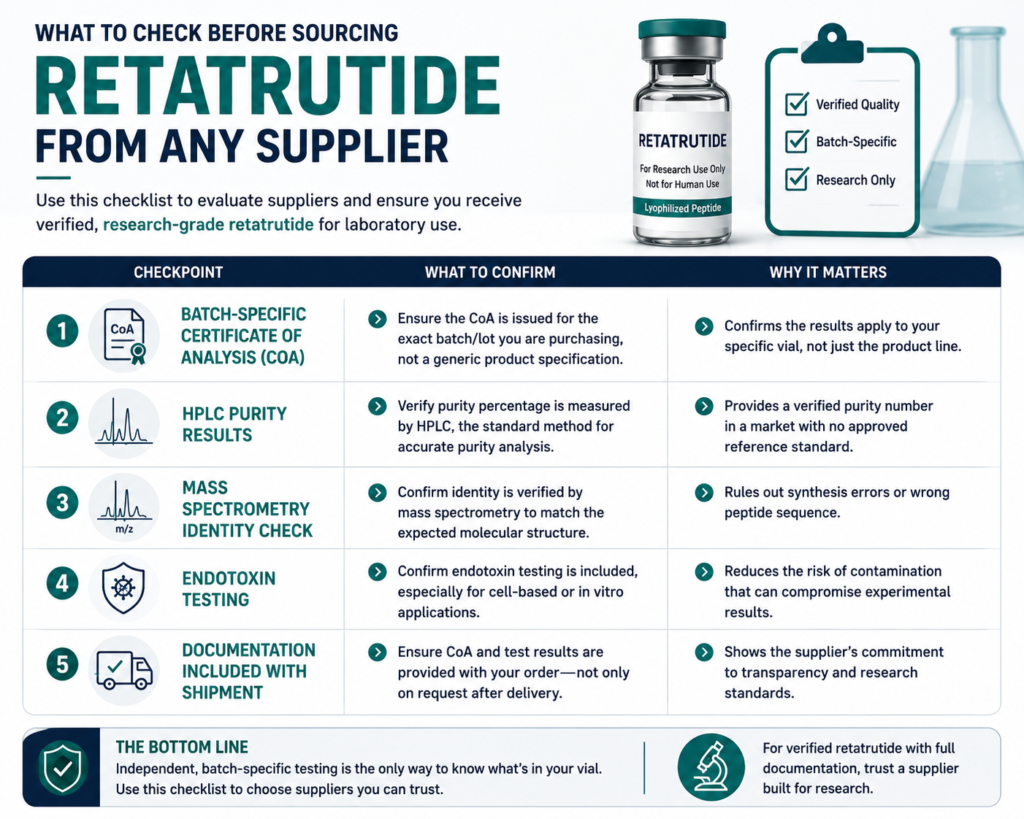
A few checks apply no matter which peptide supplier in Canada is being considered.
- Ask for a Certificate of Analysis tied to the exact batch being purchased, not a general spec sheet for the product line.
- Confirming the purity number comes from HPLC testing, a standard lab method for measuring exactly how pure a compound is.
- Confirm the compound’s identity has been checked by mass spectrometry, a test that verifies the molecule is what the label says it is.
- Confirm endotoxin testing is included if the compound will be used in any cell-based work, since contamination there can quietly undermine an entire experiment.
- Confirm the documentation ships with the order, not only on request afterward.
These checks apply to any newer, high-demand compound, not just retatrutide. A supplier that already applies them consistently is a stronger sign of reliability than any claim about purity printed on a product page.
How Helix Forge Canada documents retatrutide before it ships
Helix Forge applies the same standard to retatrutide that it applies across its entire Metabolic Signal category: a batch-specific CoA, HPLC purity results, and mass spectrometry identity confirmation, all issued before the order ships. That standard does not change based on how new or in-demand a compound happens to be.
A researcher reviewing documentation for retatrutide should expect the same level of detail as for any longer-established compound in the catalog, not a lighter version because the compound is newer to the market.
| What to Look For | Why It Matters |
| Batch-specific CoA | Confirms the exact batch, not a general spec |
| HPLC purity results | Gives a verified number where no approved reference exists |
| Mass spectrometry identity check | Rules out synthesis mistakes, more likely in a complex compound |
Bottom Line
Sourcing a compound like retatrutide carries more risk than sourcing an established one, simply because there is nothing approved to compare it against. The fix is not complicated: batch-specific testing, issued before the order ships, tied to the exact lot received, applied consistently regardless of how new or popular the compound is. Helix Forge Canada applies that standard across its catalog.
Review the current Metabolic Signal listings at helixforge.co to see what documentation is available for a specific compound before ordering.
Frequently asked questions about sourcing retatrutide for research
Is retatrutide approved for any use in Canada?
No. It remains an investigational compound. It has not been approved by Health Canada or the CFIA and is not sold through any approved pharmaceutical channel.
Why does documentation matter more for a compound like retatrutide?
Because there is no approved version to compare a sample against, a batch-specific CoA is the only outside check a researcher has that the compound matches what the label says.
What should a researcher check before ordering it from a supplier?
A batch-specific CoA, HPLC purity results, mass spectrometry identity confirmation, and endotoxin testing if the compound will be used in cell-based work.
Does high demand affect research-grade quality?
It can. A sudden spike in demand tends to bring in suppliers without established testing, which makes independent, batch-specific documentation a bigger filter than usual. Demand alone says nothing about whether a specific batch was tested properly.