
When researchers or institutional procurement teams evaluate Helix Forge, the question is not simply whether a compound appears in a catalog. The more useful question is whether the supplier can provide clear documentation showing what the compound is, how it was tested, and how the order fits within a research-only framework.
So in this article, we’ll be showing how Helix Peptides handles all the necessary compliance for documented compounds in every order placed.
HelixForge approaches these inquiries through documented research policies, independent testing, batch-specific Certificates of Analysis, and a defined process for compliance questions.
What Does Helix Forge Mean by Research-Only Supply?
Helix Forge in Canada defines its compounds as materials intended for laboratory and in vitro research rather than human, veterinary, therapeutic, or personal use.
Its compliance policy states that this research-only designation is reflected across product listings, content, order confirmations, and shipping documentation.
This distinction matters when evaluating peptide suppliers in Canada. Research institutions need to know that the material they are purchasing is being supplied within a clearly defined research context, rather than being marketed as a consumer health product.
How Does Helix Forge Handle Compliance Inquiries?
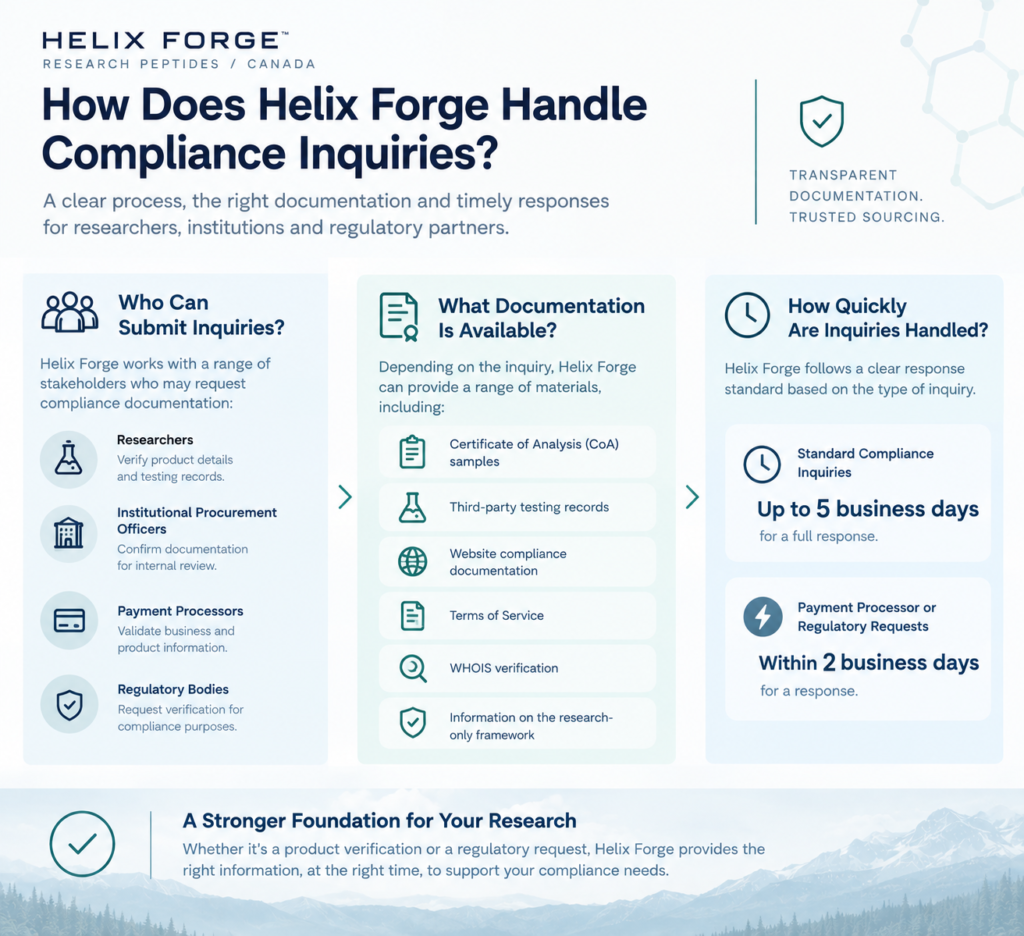
Helix Forge has a defined process for researchers and organizations that need documentation before placing an order. Its compliance policy specifically identifies researchers, institutional procurement officers, payment processors, and regulatory bodies as parties that may request verification documentation.
Depending on the inquiry, the company states that it can provide materials such as:
- CoA samples
- Third-party testing records
- Website compliance documentation
- Terms of Service
- WHOIS verification
- Information concerning its research-only framework
The published policy gives standard compliance inquiries a stated response window of up to five business days, with payment processor or regulatory requests targeted for response within two business days.
For an institution reviewing a potential supplier, this creates a clearer starting point than relying only on product-page descriptions.
What Documentation Should Researchers Expect From Helix Peptides?
The most useful documentation connects the compound being ordered to a specific analytical record. Helix Forge states that every order includes a batch-specific Certificate of Analysis from an independent third-party laboratory, with the CoA issued before the compound ships.
Its published quality process includes:
| Documentation | What it establishes |
| Batch number | Connects the material to a specific production run |
| HPLC purity | Reports the percentage of the sample represented by the target compound |
| Mass spectrometry | Provides identity confirmation |
| Testing laboratory | Identifies the independent facility performing the analysis |
| Certificate of Analysis | Records the analytical results for the specific batch |
| Endotoxin testing | Provides relevant contamination data where applicable |
For research documentation, the distinction between purity and identity is particularly useful. HPLC and mass spectrometry answer different questions, so having both records gives a researcher more information than a single percentage printed on a product page.
Why Does Batch-Specific Testing Matter?
A batch-specific record provides traceability between the material received and the analytical result. This matters for research reproducibility because a generic product specification does not necessarily tell a laboratory what was tested in the specific batch it received.
Helix Forge’s research guide explains that the batch number on the CoA ties the order to a specific production run. The same documentation identifies the compound, HPLC purity, molecular weight, mass spectrometry result, testing laboratory, and relevant endotoxin information.
The timing is also relevant. Helix Forge states that its CoA is available before shipment, allowing researchers to review the analytical record before the material arrives at their facility.
Helix Peptides Canada: What Should Institutions Check?
For institutions researching Helix Peptides Canada or comparing search terms such as Helix Labs Peptides, the same procurement questions should apply regardless of how a supplier is described online.
A research buyer should check:
- Research-use classification: Confirm that the supplier clearly defines the intended use and restrictions.
- Independent testing: Check whether analytical testing is performed externally rather than solely reported by the supplier.
- Batch-specific CoA: Confirm that the documentation corresponds to the actual production batch.
- Identity and purity data: Look for appropriate analytical methods, including HPLC and mass spectrometry where applicable.
- Compliance documentation: Determine whether the supplier can provide information needed for institutional procurement or compliance review.
- Traceability: Confirm that the batch number and analytical record can be retained with the laboratory’s research documentation.
These checks provide a more useful basis for supplier evaluation than price, catalog size, or marketing language alone.
Why Helix Forge Can Be Relevant to Canadian Research Procurement
Helix Forge positions its Canadian supply model around documentation and analytical verification rather than consumer-facing peptide claims.
That framework can be useful when a research team needs more than a product listing. A procurement review may require evidence of what was tested, who performed the analysis, which batch was supplied, and whether the supplier’s operating framework matches the intended research use.
For teams evaluating Helix Peptides Canada, we provide a documented path for reviewing these questions before procurement. Researchers can review the applicable compound information, request compliance documentation where needed, and examine batch-specific analytical records before shipment.
What Researchers Should Verify Before Ordering
The value of a peptide supplier is easier to assess when the evaluation starts with documentation rather than marketing claims. For Canadian research teams, that means checking research-use classification, independent testing, batch traceability, identity and purity results, and the supplier’s ability to respond to legitimate compliance inquiries.
Helix Forge has built its published supply process around those elements, including independent laboratory testing, batch-specific CoAs, and a defined compliance policy for research and institutional inquiries.
Frequently Asked Questions
Does Helix Forge provide compliance documentation?
Yes. Helix Forge can provide CoA samples and its Terms of Service for legitimate compliance verification requests.
Are Helix Forge peptides intended for human use?
No. Helix Forge states that its compounds are intended exclusively for laboratory and in vitro research and are not intended for human consumption, therapeutic use, diagnostic application, veterinary use, or personal use.
Does every Helix Forge order include a CoA?
Helix Forge states that every compound ships with a batch-specific Certificate of Analysis from an independent third-party laboratory, issued before shipment.