
“Wolverine” is one of the most searched nicknames in peptide research, yet it describes no single compound. It is shorthand for BPC-157 and TB-500 supplied together, and anyone evaluating a premium Canadian peptide supplier should know what the name does and does not tell them.
The nickname comes from online marketing, not from the science itself. What matters for researchers is what each compound is, how a two-compound blend is verified, and where both stand with regulators.
Key Takeaways
- The “Wolverine” blend is an informal name for BPC-157 and TB-500 combined in one product.
- BPC-157 is a synthetic 15-amino-acid peptide based on a sequence from a protein found in gastric juice.
- TB-500 is a synthetic peptide derived from thymosin beta-4, a protein known for binding actin.
- Almost all published data on both compounds comes from cell and animal studies.
- A blend needs separate identity and purity data for each compound, plus a stated ratio.
- Neither compound is approved by Health Canada or the FDA, and both are prohibited in sport by WADA.
- In Canada, both are supplied strictly as research compounds for laboratory study.
Where Does the “Wolverine” Name Come From?
The “Wolverine” name borrows from a comic book character known for rapid healing, and it is used mainly in online wellness and fitness marketing. In research terms, it simply means BPC-157 and TB-500 supplied together, often in a single vial.
That origin is worth keeping in mind. A nickname built on a fictional ability signals marketing intent, not evidence. Researchers should set the label aside and evaluate the blend on its contents, its ratio, and its documentation.n
What Are BPC-157 and TB-500?
BPC-157 and TB-500 are two unrelated synthetic peptides with different origins, sizes, and research focuses. They are grouped together because both are studied in cell and tissue signaling models, but they act through different mechanisms and need separate verification.
BPC-157
BPC-157, short for Body Protection Compound-157, is a 15-amino-acid synthetic sequence based on a fragment of a protein found in human gastric juice. It is studied in laboratory models of cellular signaling, although no dedicated receptor for it has been confirmed.
TB-500
TB-500 is a synthetic peptide derived from thymosin beta-4, a protein present in most human and animal cells. Thymosin beta-4 is well characterized as an actin monomer sequestering protein, a role described in published biochemical research indexed by the NIH. Research on TB-500 focuses on actin dynamics and cell migration.
| Feature | BPC-157 | TB-500 |
| Origin | Sequence from a gastric juice protein | Derived from thymosin beta-4 |
| Size | 15 amino acids | Fragment of a 43-amino-acid parent protein |
| Main research focus | Cellular signaling in laboratory models | Actin binding and cell migration |
| WADA classification | S0, non-approved substances | S2, as a thymosin beta-4 derivative |
Two Compounds, One Nickname: The Full Picture
The table compares the two compounds side by side. The infographic below adds where they fit, what to verify in a blend, and where both stand with regulators.
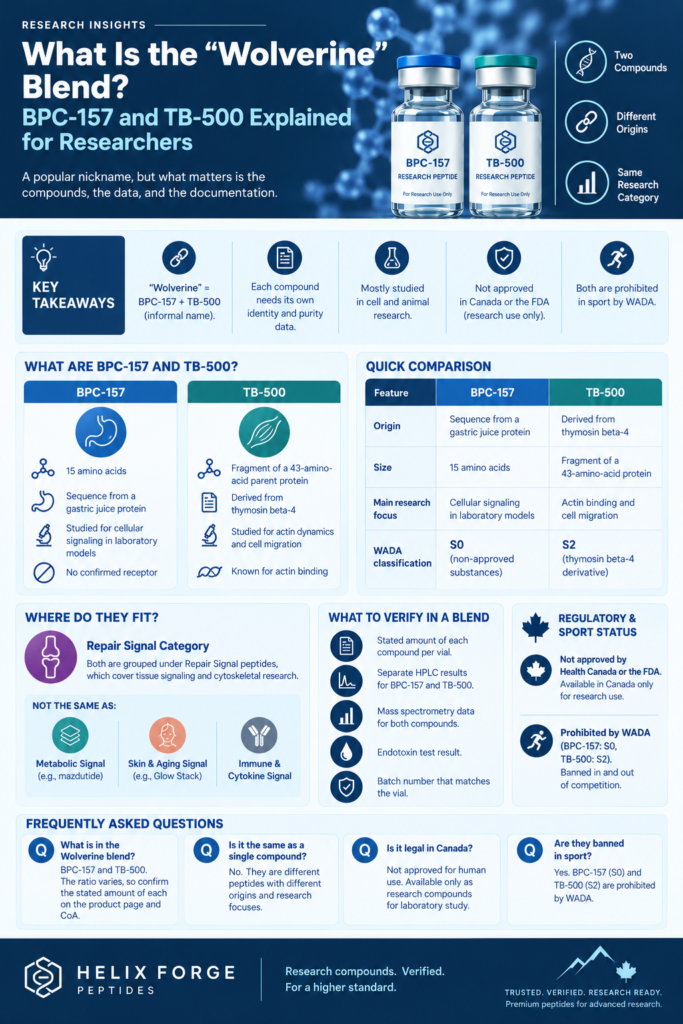
How Are the Two Compounds Classified?
Both compounds sit in the Repair Signal category, which groups peptides studied for tissue signaling and cytoskeletal research. Classification helps researchers compare each compound with the right reference materials.
The Repair Signal Category
The Repair Signal research guide explains how BPC-157, TB-500, and IGF-1 LR3 are grouped and how their research focuses differ within that category.
The Helix Forge Research Library
For a wider view of every compound class, the Helix Forge verified peptide research library lists catalog compounds by research category, alongside the documentation standard each one carries.
What Should Researchers Verify in a Two-Compound Blend?
A blend doubles the verification work. Each compound needs its own identity and purity data, and the CoA should state how much of each is in the vial. Without that, there is no way to tell whether the blend matches its label.
Before ordering any BPC-157 and TB-500 blend, check for:
- A stated amount of each compound per vial, not just a combined total.
- Separate HPLC peaks identified for BPC-157 and TB-500.
- Mass spectrometry data confirming the identity of both compounds.
- An endotoxin result, since purity testing does not detect bacterial contamination.
- A batch number that links the CoA to the vial being supplied.
What “Premium” Should Mean
“Premium” is only meaningful when it is backed by documentation. The Helix Forge premium Canadian peptide page explains how Helix Forge defines that standard for its catalog.
Where to Source Verified Compounds
Supplier choice matters as much as the CoA itself. The guide to where to buy verified research peptides in Canada covers how to compare suppliers before placing an order.
What Is the Regulatory and Sport Status of BPC-157 and TB-500?
Neither BPC-157 nor TB-500 is approved for human use by Health Canada or the FDA. In Canada, both can only be supplied as research compounds for laboratory study, and no “research use only” label changes that status.
Sport regulators take a firm line too. The World Anti-Doping Agency’s Prohibited List names BPC-157 under its non-approved substances class and lists thymosin beta-4 derivatives, including TB-500, under peptide hormones and related substances. Both are prohibited at all times.
Research involving animals carries its own requirements. In Canada, any animal-based study needs approval from an institutional animal care committee working under the Canadian Council on Animal Care guidelines, which set the standards for ethical animal use in science.
Look Past the Nickname
The “Wolverine” label sells a story, but the vial holds two separate compounds with separate research records. Treating them as one product hides exactly the details a study depends on.
Read the blend the way a lab would: two identities, two purity results, one stated ratio, and one batch number tying it all together.
Frequently Asked Questions
What is in the Wolverine blend?
The Wolverine blend combines two synthetic peptides, BPC-157 and TB-500. The ratio varies between suppliers, so researchers should confirm the stated amount of each compound on the product page and the CoA.
Is the Wolverine blend the same as a single compound?
No. BPC-157 and TB-500 have different origins, structures, and research focuses. Each needs its own identity and purity confirmation, even when supplied in one vial.
Is the Wolverine blend legal in Canada?
BPC-157 and TB-500 are not approved by Health Canada for human use. In Canada, they can only be supplied as research compounds for laboratory study.
Are BPC-157 and TB-500 banned in sport?
Yes. WADA prohibits BPC-157 as a non-approved substance and TB-500 as a thymosin beta-4 derivative. Both are banned in and out of competition.