
Mazdutide is one of the most searched compounds in metabolic signaling research, and that demand makes careless sourcing more likely. For any lab looking into peptide Canada suppliers, the first question is not price but whether the documentation confirms exactly what is in the vial.
A product name and a purity percentage are not enough on their own. The checks below cover what a mazdutide batch record should show and how to read it before a single assay begins.
Key Takeaways
- Mazdutide (IBI362, LY3305677) is a synthetic oxyntomodulin analogue that acts on both the GLP-1 receptor and the glucagon receptor.
- Its fatty-acyl side chain makes full identity confirmation by mass spectrometry essential, not optional.
- Published molecular data varies between sources, so the CoA should match the formula and weight of the compound actually supplied.
- HPLC purity and net peptide content measure different things and should never be read as one figure.
- Endotoxin results matter for any cell-based assay, because purity testing does not detect them.
- Mazdutide is not authorized by Health Canada, so supply in Canada sits strictly within the research-use framework.
- The batch-specific CoA should be available before the compound ships, not after.
What Is Mazdutide, and Why Does Its Structure Matter for Sourcing?
Mazdutide is a long-acting synthetic analogue of oxyntomodulin, a gut hormone that binds both the GLP-1 receptor (GLP-1R) and the glucagon receptor (GCGR). Its structure includes a fatty-acyl side chain, which adds a synthesis step and makes identity testing more demanding than for an unmodified peptide.
Early preclinical work presented in the American Diabetes Association’s journal Diabetes described LY3305677 as an oxyntomodulin analogue with a fatty acyl side chain that acts through both receptors. That modification is exactly what a supplier’s testing has to confirm. A peptide with the right backbone but an incomplete side chain is a different compound.
Molecular data is the next thing to check. MedChemExpress’s mazdutide reference listing gives CAS number 2259884-03-0, molecular formula C210H322N46O67, and a molecular weight of 4563.06.
Some databases list a different formula for the same compound, which is a good reason to compare the expected mass on a CoA against a named reference.
What Should Researchers Check on a Mazdutide CoA?
A mazdutide Certificate of Analysis should confirm identity, purity, and batch traceability for the exact lot being supplied. At minimum, that means HPLC purity data, mass spectrometry results showing observed mass against expected mass, an endotoxin result, and a batch number that matches the vial label.
| CoA Check | What It Confirms | Why It Matters for Mazdutide |
| HPLC purity | Share of peptide material that is the target sequence | Separates intact mazdutide from synthesis byproducts |
| Mass spectrometry | Observed molecular weight against expected weight | Confirms the fatty-acyl modification is complete |
| Net peptide content | Share of total powder weight that is peptide | Water and salts lower it, which affects solution concentration |
| Endotoxin test | Presence of bacterial endotoxins | Purity testing cannot detect this contamination |
| Batch number | Link between the CoA and the vial | Keeps results traceable across a study |
A few warning signs are worth knowing before comparing suppliers:
- A CoA with no batch number, or one that does not match the vial label.
- Purity reported as a percentage with no chromatogram or method stated.
- No mass spectrometry data at all, which leaves identity unconfirmed.
- Documentation offered only after delivery, or only on request.
Your Mazdutide Pre-Order Checklist, Visualized
Every check above, plus storage and regulatory status, fits on one page. Keep the checklist below on hand when comparing mazdutide suppliers.
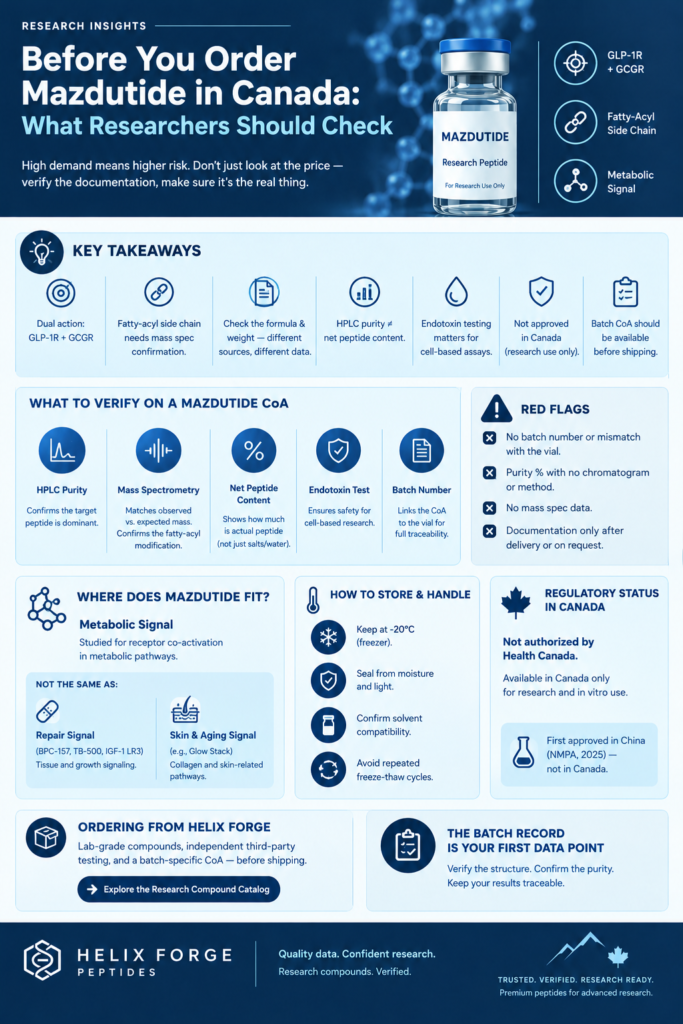
Where Does Mazdutide Sit Among Peptide Research Categories?
Mazdutide belongs to the Metabolic Signal category, alongside other compounds studied for receptor co-activation in metabolic pathways. Knowing its category helps researchers compare it with the right reference compounds and avoid treating unrelated peptides as interchangeable.
How Repair Signal Compounds Differ
Repair Signal compounds are studied for very different pathways. BPC-157, TB-500, and IGF-1 LR3 are examined for tissue signaling, cytoskeletal dynamics, and growth factor receptor activity rather than incretin or glucagon receptor pharmacology. The Repair Signal research guide covers how that category is classified.
How Skin and Aging Signal Compounds Differ
Skin and Aging Signal compounds form another separate lane, centred on copper-dependent and collagen-related signaling research. The Glow Stack research guide covers the compounds in that category. Because they are often supplied as blends, they raise different verification questions from a single compound like mazdutide.
How Should Mazdutide Be Handled After Delivery?
Lyophilized mazdutide should go into stable freezer storage at around -20°C soon after arrival, sealed against moisture and light. The batch number and date received should be logged immediately, so the CoA and storage record can be matched later.
The lipidated structure gives mazdutide different solubility behaviour from simpler peptides, so labs should confirm solvent compatibility before preparing stock solutions for an assay.
Repeated freeze-thaw cycles add moisture and can degrade the compound over the course of a project.
What Is Mazdutide’s Regulatory Status in Canada?
Mazdutide is not authorized for sale as a drug in Canada. It received its first market approval from China’s National Medical Products Administration in 2025, but in Canada it can only be supplied as a research compound for laboratory and in vitro study.
Innovent Biologics, which holds the Chinese rights under a licence from Eli Lilly, announced the NMPA approval in June 2025. That approval applies in China only. Without a Health Canada authorization, a batch-specific CoA is the only independent record a Canadian lab has of what a mazdutide sample contains.
Ordering From the Helix Forge Catalog
Helix Forge supplies mazdutide strictly for laboratory research, with independent third-party testing and a batch-specific CoA issued with the order confirmation, before the compound ships. Researchers can review the full Helix Forge research compound catalog to compare mazdutide with other Metabolic Signal compounds before ordering.
The Batch Record Is Your First Data Point
Mazdutide’s dual-receptor activity and lipidated structure make it a demanding compound to verify. The checks that matter most are a mass spectrometry result that confirms the full structure, HPLC purity with a visible method, and a batch number that ties the CoA to the vial.
Running those checks before ordering gives every study a documented starting point. That record is what makes later results traceable, comparable, and defensible.
Frequently Asked Questions
What is mazdutide used for in research?
Mazdutide is studied for GLP-1 receptor and glucagon receptor co-activation in metabolic signaling models. Researchers often compare its receptor binding and downstream cAMP signaling with single-receptor reference compounds in controlled in vitro conditions.
Why is mass spectrometry so important for mazdutide?
Mazdutide carries a fatty-acyl side chain. Mass spectrometry confirms the full modified structure is present, which HPLC purity alone cannot show. A sample with an incomplete modification would be a different compound.
Is mazdutide approved in Canada?
No. Mazdutide has received market approval in China but is not authorized by Health Canada. In Canada, it can only be supplied as a research compound for laboratory study.
What purity should a mazdutide CoA show?
Helix Forge holds its catalog compounds to a minimum of 99% purity by HPLC. The CoA should also show the testing method, mass spectrometry identity data, an endotoxin result, and a batch number.