
The Glow peptide blend combines three compounds in a single vial: GHK-Cu, BPC-157, and TB-500. Each has a distinct research target, and the name itself is an industry convention rather than a fixed or trademarked formula, which means the composition behind the label matters more than the label itself.
That total figure is only useful if it breaks down into something a researcher can actually verify against the certificate that ships with it.
At Helix Forge, we offer a variety of compounds for research, including Glow Stack Peptide Canada under the skin and aging categories. If it’s already in your cart, or you’re planning to add it, we recommend reading this article beforehand.
What the Glow peptide blend actually contains
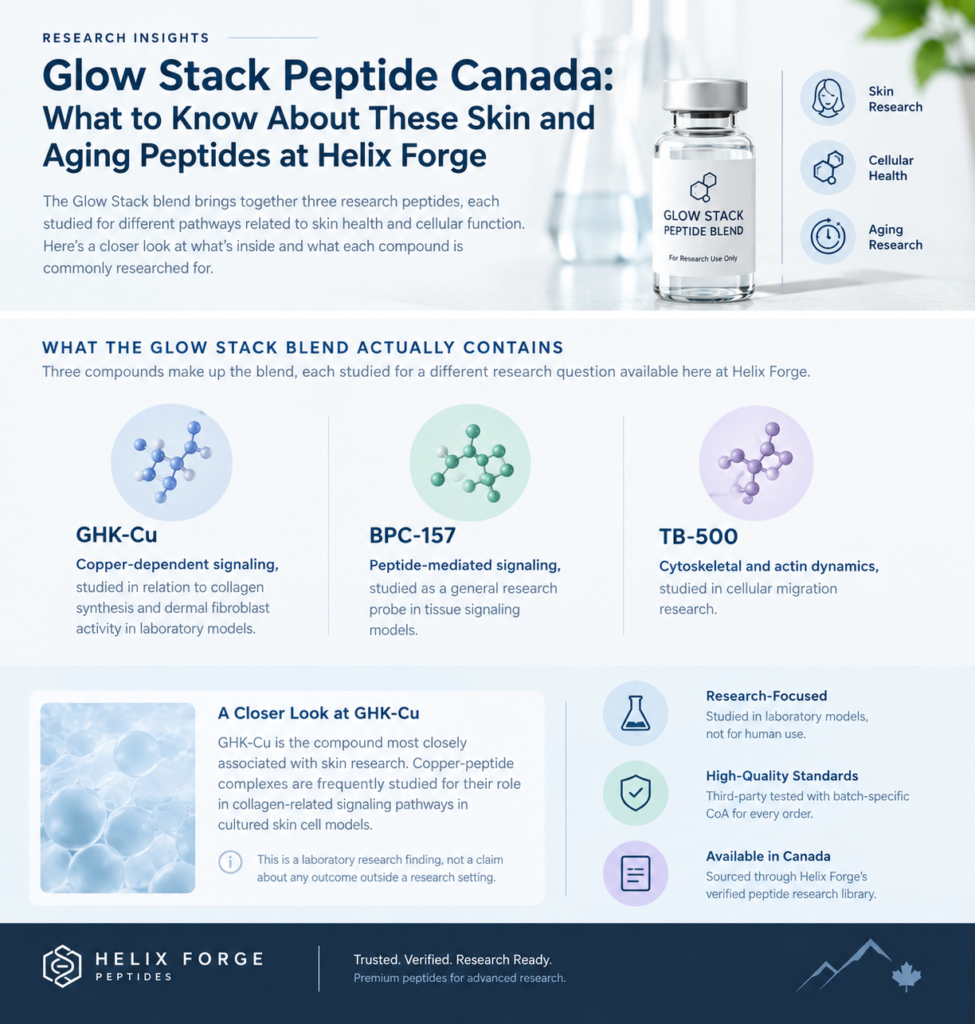
Three compounds make up the blend, each studied for a different research question available here at Helix Forge.
| Compound | Research Focus |
| GHK-Cu | Copper-dependent signaling, studied in relation to collagen synthesis and dermal fibroblast activity in laboratory models. |
| BPC-157 | Peptide-mediated signaling, studied as a general research probe in tissue signaling models |
| TB-500 | Cytoskeletal and actin dynamics, studied in cellular migration research |
GHK-Cu is the compound most closely associated with this category, since copper-peptide complexes are frequently studied for their role in collagen-related signaling pathways in cultured skin cell models specifically. That is a laboratory research finding, not a claim about any outcome outside a research setting.
How Glow relates to KLOW
The two blends are easy to confuse because they share three of the same components. KLOW adds a fourth compound, KPV, an α-MSH fragment studied for melanocortin-linked signaling, on top of the same GHK-Cu, BPC-157, and TB-500 base. If a study’s research question does not involve the melanocortin-linked pathway, the three-compound version is the simpler preparation, since it removes a variable rather than adding one.
Why fewer compounds can mean a cleaner comparison
A three-compound blend is easier to interpret than a four-compound one for the same reason a smaller sample size is easier to control. Fewer variables means fewer possible interactions to account for when reading a result. That does not make the three-compound version better in every case, only simpler for research questions that do not require the fourth pathway.
A study designed specifically around melanocortin-linked signaling would still need the four-compound version, since removing KPV also removes the pathway the study is meant to examine.
What a complete blend CoA should include
A blend needs more documentation than a single compound does, since each component and the ratio between them are both facts to verify, not assume. And that is exactly what we do here at Helix Forge Peptides. This applies just as much to a three-compound blend as it does to a four-compound one, since removing one component does not remove the need to confirm the rest.
- Per-component identity, not a single combined mass figure for the vial
- The stated ratio between compounds, since the name alone does not guarantee it
- A batch reference matching the specific vial in hand
- The analytical method disclosed, typically HPLC for purity and mass spectrometry for identity
- A testing date, since peptide material does not remain stable indefinitely
A single purity percentage for a three-compound, 70mg vial has not actually told a researcher what is inside it.
What the published research actually covers
GHK-Cu, BPC-157, and TB-500 each have a body of published research individually, largely in vitro and preclinical work examining specific signaling pathways. Far less exists on the three-compound combination as a single research subject, and what does exist tends to be narrower in scope than the individual-compound literature.
Claims about what the blend does as a whole tend to be extrapolations from separate single-compound findings, not results specific to the combined preparation. That distinction is worth stating plainly rather than glossing over, since it shapes what a researcher can reasonably expect a blend study to demonstrate, and what still needs to be established through single-compound work first.
How Helix Forge Canada documents the Glow blend before it ships
HelixForge applies the same documentation standard to the Glow stack peptide Canada that it applies across the rest of the catalog. For a multi-compound product, that means identity and purity confirmation for each component, not a single figure for the combined vial, issued before the order ships.
Frequently asked questions about the Glow peptide blend
What does the Glow peptide blend contain?
Three compounds in one vial: GHK-Cu, BPC-157, and TB-500, with a combined mass of 70mg in Helix Forge Canada’s current listing.
How is Glow different from KLOW?
KLOW combines the same three compounds plus a fourth, KPV, which is studied for melanocortin-linked signaling. Glow is the simpler three-compound version.
Why does GHK-Cu get the most attention in this category?
It is a copper-peptide complex studied for its role in collagen-related signaling in laboratory dermal cell models, which places it at the center of skin and tissue signaling research specifically.
Does a blend need different documentation than a single compound?
Yes. A blend requires per-component identity and purity confirmation and a disclosed ratio, since a single combined figure does not indicate what each compound contributes.