
BPC-157, TB-500, and IGF-1 LR3 get grouped together constantly under the same label, but they do not share a mechanism. What actually connects them is the research question behind Repair Signal peptides as a category: tissue repair signaling in a laboratory model, not any outcome in a person or animal.
Before you place your Helix Forge Peptides order, start with the basics. Learn what repair signal peptides are, how they are studied, and what researchers should know about them.
BPC-157, TB-500, and IGF-1 LR3 Compared
Before we get any further, we’ll give you an overview for the most common repair signal peptides in our research library here at Helix Forge Canada.
| Compound | Structural Class | Primary Research Focus |
| BPC-157 | Synthetic pentadecapeptide (15 amino acids) | Angiogenesis and tissue repair signaling |
| TB-500 | Thymosin Beta-4 fragment | Actin regulation and cellular migration |
| IGF-1 LR3 | Long-arginine IGF-1 analogue | Growth factor receptor signaling |
What defines the Repair Signal Category
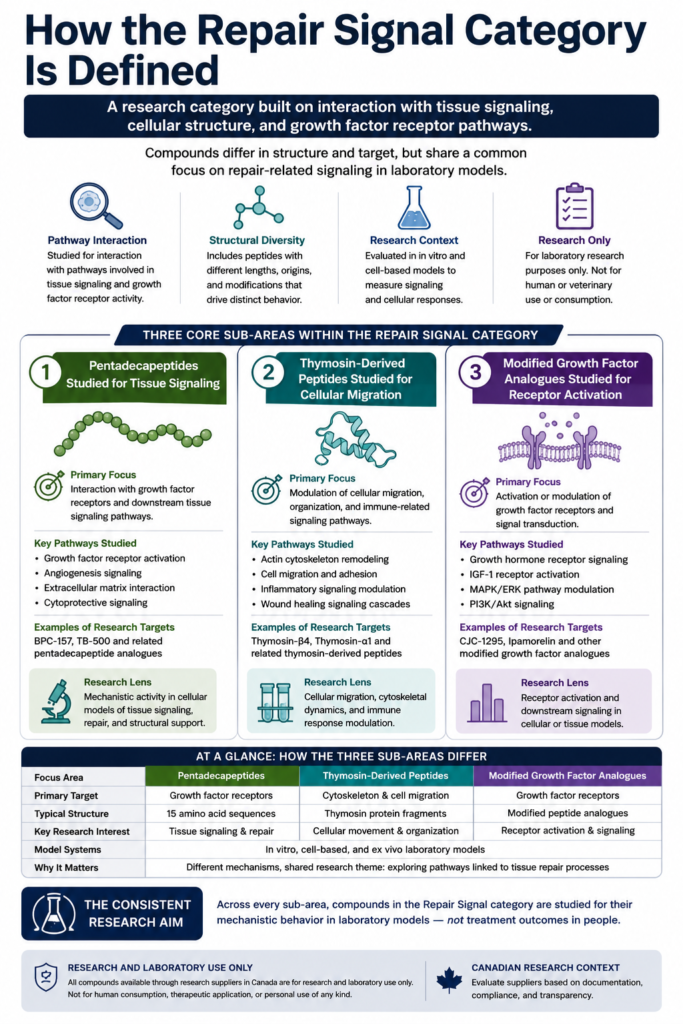
Repair signal peptides are studied for their interaction with pathways involved in tissue signaling, cellular structure, and growth factor receptor activity. For researchers in Canada evaluating suppliers, that breadth is exactly why the compounds inside this category differ significantly in structure and target, even though they share a general research theme.
Three sub-areas make up most of the category:
- Pentadecapeptides studied for tissue signaling
- Thymosin-derived peptides studied for cellular migration
- Modified growth factor analogues studied for receptor activation
BPC-157 and tissue repair signaling research
BPC-157 is a synthetic pentadecapeptide, a 15-amino acid sequence, studied for its interaction with growth hormone receptor expression and downstream tissue signaling pathways in laboratory models. Much of the published research on BPC-157 focuses on angiogenesis, the formation of new blood vessels, and its effects on tissue signaling in animal studies.
It is one of the more extensively studied compounds in this category, which also means expectations for documentation quality tend to be higher. A researcher sourcing BPC-157 has more published literature to compare a supplier’s claims against than with a newer or less established compound.
Why batch consistency matters more for well-studied compounds
A compound with a large body of published research invites more scrutiny of any given batch, not less. If a study’s results do not align with prior published findings, a batch documentation gap is one of the first variables worth ruling out, and it can only be ruled out if the CoA and testing data actually exist to compare against.
TB-500 and cellular migration research
TB-500 is a synthetic peptide fragment derived from Thymosin Beta-4, studied for its role in actin regulation and cellular migration. Thymosin Beta-4 itself is a naturally occurring protein involved in cell structure, and the synthetic fragment is studied specifically for how it influences movement and signaling in cell models related to tissue repair.
The research question here is distinct from BPC-157’s angiogenesis focus. TB-500 research centers on cellular movement and structural regulation, which is why the two compounds are often discussed together despite targeting different biological processes entirely.
IGF-1 LR3 and growth factor receptor signaling
IGF-1 LR3 is a long-arginine analogue of insulin-like growth factor 1, modified to extend its stability compared to the native peptide. It is studied for growth factor receptor signaling and downstream pathway activation in laboratory models, distinct from both the angiogenesis focus of BPC-157 and the cellular migration focus of TB-500.
Because IGF-1 LR3 is a modified analogue rather than the native peptide sequence, identity confirmation through mass spectrometry matters as much as purity data. A batch that is technically pure but incorrectly modified would still fail to represent the compound a study is actually designed around.
Why documentation matters the same way across all three
Despite targeting different pathways, BPC-157, TB-500, and IGF-1 LR3 all need the same underlying verification:
- A batch-specific Certificate of Analysis tied to the exact lot, not a general product-line specification
- HPLC purity data with the testing method disclosed
- Mass spectrometry identity confirmation, which matters most for a modified analogue like IGF-1 LR3
Helix Forge applies that standard across the Repair Signal category the same way it does across every other category in the catalog, regardless of which compound or research question is involved. [VERIFY: confirm current stock, lead times, and the exact Repair Signal category description live on the Helix Forge Canada site before publishing.]
The research question determines which compound fits a given study. The documentation standard should not vary based on that answer, and a researcher comparing suppliers should treat any gap in that consistency as a warning sign rather than a minor omission.
Final Research Considerations
BPC-157, TB-500, and IGF-1 LR3 represent three distinct research questions inside one broad category: angiogenesis and tissue signaling, cellular migration, and growth factor receptor activation. What stays constant is the documentation a researcher should expect regardless of which compound a study calls for.
Forge Peptides applies batch-specific verification across the full Repair Signal catalog, so the compound chosen depends on the research question, not on which one happens to be better documented. Review the current Repair Signal catalog at helixforge.co to see the documentation behind a specific compound before ordering.
Frequently Asked Questions About Repair Signal peptides
What does the Repair Signal category actually cover?
Compounds studied for tissue repair signaling, cellular migration, or growth factor receptor activity in laboratory models, grouped by research theme rather than a single shared mechanism. Researchers in Canada evaluating a new supplier should expect the same documentation standard across every compound in the category.
How is BPC-157 different from TB-500?
BPC-157 is a synthetic pentadecapeptide studied primarily for angiogenesis and tissue signaling. TB-500 is a Thymosin Beta-4 fragment studied for cellular migration and actin regulation. Both relate to tissue repair research but target different biological processes.
Why does identity confirmation matter more for IGF-1 LR3?
It is a modified analogue rather than the native peptide, so mass spectrometry confirmation is needed to verify the modification was completed correctly, not just that the sample is pure.
Do all Repair Signal compounds require the same documentation?
Yes. Batch-specific CoA data, HPLC purity verification, and mass spectrometry identity confirmation apply across the category regardless of which compound or pathway is involved.