
A vial of research peptide can look perfectly fine and still be compromised. Degradation from poor storage rarely shows up as a visible warning sign. It shows up later, as inconsistent results a lab cannot fully explain, sometimes weeks into a project.
What happens in the first thirty minutes after a shipment arrives often decides how reliable that compound stays for the rest of the study.
Helix Forge Canada ships every order with batch-specific CoA documentation before the compound leaves the warehouse, so the guide below builds on the same verification standard researchers can review.
Key takeaways
- Inspect a shipment immediately; do not let it sit before checking the seal and label.
- Freeze lyophilized peptides at approximately -20°C for long-term storage.
- Refrigerate reconstituted peptides at 2°C to 8°C and never refreeze them.
- Freeze-thaw cycling causes more damage than most researchers expect.
- Storage logs and CoA documentation work together. Neither one is complete without the other.
What happens the moment a peptide shipment arrives
A shipment left at a loading dock or mailroom desk for hours starts losing whatever advantage careful packaging was supposed to provide. The right move is to unpack it promptly, check the vial for an intact seal, and confirm the label matches both the order and the accompanying Certificate of Analysis.
Lyophilized peptides tolerate short periods at room temperature reasonably well, which is one reason most peptide suppliers in Canada ship compounds in freeze-dried form. That tolerance still has limits.
A vial that looks swollen, discolored, or improperly sealed should get flagged with the supplier immediately, before it enters storage and before any assumptions get made about what is actually inside it.
Where the vial goes next, and how quickly, is what determines how long that integrity holds.
How to store lyophilized peptides for long-term use
For a compound that will not be used within the next few weeks, freezer storage is the safer default.
- Store sealed lyophilized vials at approximately -20°C for long-term holding.
- Keep the freezer stable. Units with frequent door traffic or inconsistent cycling defeat the purpose.
- Seal vials against moisture, since humidity is one of the fastest ways to compromise a freeze-dried compound.
- Limit light exposure using original packaging or a dark storage container.
- Label every vial with compound name, batch number, and date received.
Temperature gets most of the attention in these conversations, but a freezer that fluctuates does more damage over time than a slightly warmer unit that stays consistent. Stability matters more than raw cold.
Why freeze-thaw cycling is the real risk
If you think the simple way of thawing peptides doesn’t do any harm to its quality, then that couldn’t be further away from the truth.
Every trip a frozen vial makes from freezer to room temperature and back introduces condensation, and that moisture works against the compound at a molecular level. Minimizing how often a vial gets pulled out and returned does more for long-term integrity than any single temperature adjustment.
A simple log of freezer access, tracked over the life of a project, tends to explain inconsistent results far more often than the freezer’s exact setting does.
How to store peptides during active short-term research
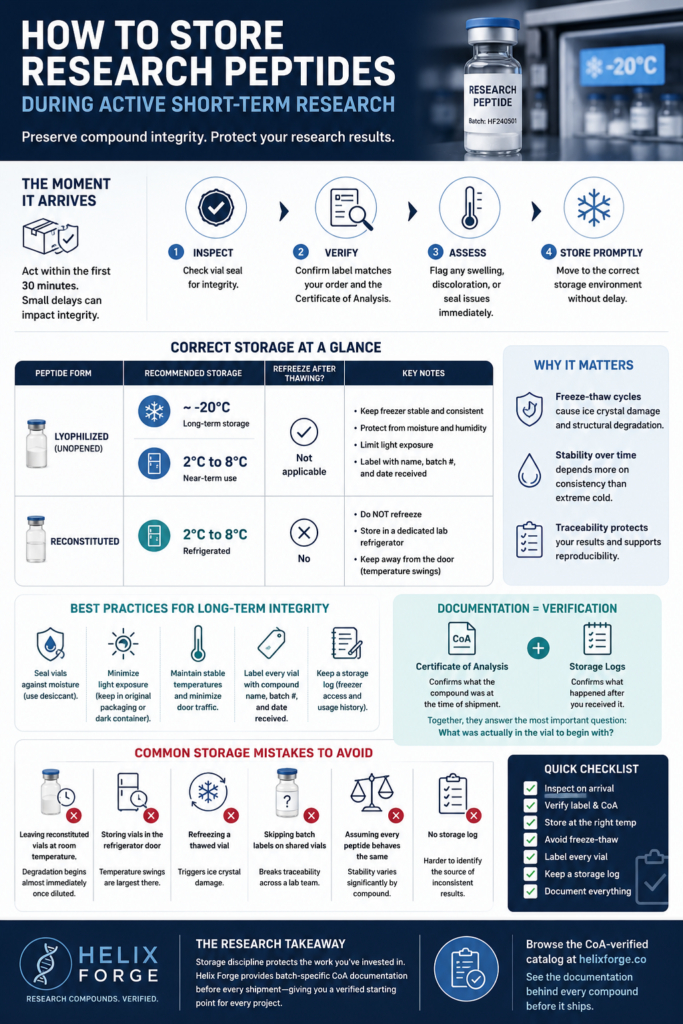
Once a peptide is reconstituted for laboratory use, it needs refrigeration at 2°C to 8°C and should never be refrozen. Ice crystal formation during a second freeze can damage the amino acid structure the entire study depends on, and it is often the single biggest avoidable source of inconsistent data in a research setting.
For a proper peptide storage, a dedicated lab refrigerator should be positioned away from the door where temperature swings are largest, giving a reconstituted compound a more stable environment than a general-purpose fridge shared with unrelated items. That stability only holds value if it can be traced back to a verified starting point.
| Peptide Form | Recommended Storage | Refreeze after thawing? |
| Lyophilized (unopened) | Approximately -20°C for long-term; 2°C to 8°C for near-term use | Not applicable |
| Reconstituted | 2°C to 8°C, refrigerated | No |
Why documentation matters as much as temperature
A Certificate of Analysis confirms what a compound was at the point of shipment. Storage logs confirm what happened to it afterward. Neither one fully answers the question a lab supervisor or ethics board is most likely to ask if a result looks off unless both exist together: what was actually in the vial to begin with.
Helix Forge issues batch-specific CoA documentation before a compound ships, giving researchers a verified baseline to compare against later. For anyone sourcing peptides for the first time, that starting point is what makes a storage log worth keeping at all.
Common storage mistakes that compromise research peptides
Most integrity problems trace back to procedure, not equipment.
| Mistake | Why it causes problems |
| Leaving a reconstituted vial at room temperature during a long session | Degradation begins almost immediately once diluted |
| Storing vials in the refrigerator door | Temperature swings are largest there |
| Refreezing a thawed vial | Triggers ice crystal damage |
| Skipping batch labels on shared vials | Breaks traceability across a lab team |
| Assuming every peptide behaves the same | Stability varies significantly by compound |
A supplier that documents purity and batch data well still cannot control what happens after delivery. That responsibility sits with the lab.
The Research Takeaway
Storage discipline protects work that starts long before a vial reaches the bench. Helix Forge is a peptides in Canada that builds that foundation with batch-specific CoA documentation issued before every shipment, giving researchers across Canada a verified starting point to log and reference throughout a project.
Browse the CoA-verified catalog at helixforge.co to see the documentation behind every compound before it ships.
Frequently asked questions about storing research peptides in Canada
What is the correct temperature to store research peptides after delivery?
Lyophilized peptides are typically stored at approximately -20°C for long-term use or refrigerated at 2°C to 8°C for near-term use. Reconstituted compounds should stay refrigerated and should not be refrozen.
How long can a lyophilized peptide stay at room temperature?
Lyophilized peptides tolerate brief periods at room temperature better than reconstituted compounds, but extended exposure still increases the risk of degradation. Moving the vial into proper storage promptly after delivery remains the safer standard.
Can a reconstituted peptide be frozen for storage?
Refreezing is generally discouraged. The freeze-thaw cycle can damage the compound’s structure and compromise research results.
Why does batch documentation matter alongside storage conditions?
A Certificate of Analysis establishes what the compound was at the time of shipment. That gives researchers a verified reference point if a result looks inconsistent after storage or handling.